
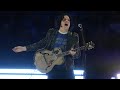
To say that Space Waltz stood out among the tuxedoed crooners and singing family groups that dominated the light entertainment show is an understatement While Riddell’s appearance caused some visible discomfort among the all-male judging panel – “this effeminate thing is very commercial in the heavy area” blathered 2ZB deejay Paddy O’Donnell, while popular entertainer Howard Morrison batted his eyelids and blew mock kisses – there was evidently a hunger for it. Released as a single only days later, ‘Out On The Street’ became the first local No.1 in four years. Alastair Riddell had seized his moment and will forever be characterised as New Zealand’s glam-rock icon; our homegrown Bowie. When Bowie died in 2016, Riddell was one of the first commentators the media went to for a soundbite. He later performed moving tributes to Bowie, performing a stirring ‘All The Madmen’ on RNZ National’s Music 101, and touring as part of the Waiting In The Sky tribute show. But Riddell was always more than just a Bowie clone. Growing up in the 1950s and 60s in the Waitakere suburb of Titirangi, his artistic sensibilities were encouraged from a young age. Titirangi at that time was a bohemian stronghold populated by actors, potters and painters, a community in which the Riddell family felt at home. Alastair’s mother had studied art at Elam; his father, a publisher, sang Irish and Scottish folk songs and had a strong interest in politics. “My parents were politically liberal and they were on a kind of bohemian fringe. They were probably not as radical as some, but there was a strong message that came through: be yourself, think for yourself. My mum always said, ‘don’t be a conformist. People who do things are not conformists’, and my dad would have agreed completely.” Though he studied classical piano, his first musical passion was the blues. In the early 60s, before the music had been popularised by the likes of The Rolling Stones and John Mayall, the young Riddell latched onto the folk blues of Lead Belly and Josh White. His parents encouraged his interest in this black American music, as it chimed with their support of the civil rights movement. In those pre-Beatle days, pop was motley fare. Elvis, he recalls, “had gone to Blue Hawaii. I went to one Elvis movie and never wanted to see another one.” But he remembers going with his elder brother Ron to a five-act bill at the Auckland Town Hall, where local rocker Johnny Devlin stood out amongst middle-of-the-road entertainers like Toni Williams and Howard Morrison. “I liked the leather and the attitude. It was raw and exciting.” The Shadows inspired Alastair, at age 12, to get his first electric guitar: a Jansen Invader (“Lake Placid blue”) with a vibrato arm...to be continued - audioculture

trax:
01 Fraulein Love 02 Seabird 03 Out On The Street 04 Angel 05 Open Up 06 Scars Of Love 07 And Up To Now 08 Love The Way He Smiles 09 Beautiful Boy…served by Gaius…



.jpg)




.jpg)




.jpg)


.jpg)


%2001.jpg)


4 comments:
Alastair Riddell & Space Waltz "Space Waltz"
…served by Gaius…
gitit! no pw
https://krakenfiles.com/view/3Cf5CzkWvz/file.html
Thank you.
Later albums please.
la musica e vita, next:
Alastair Riddell "Alastair Riddell" 1978
Alastair Riddell "Positive Action" 1983
I was there and saw that tv appearance of Space Waltz. NZ music was never the same afterward. They and Split Ends (later ...Enz) rewrote NZ's concept of what we could achieve musically.
'Studio One' introduced a slew of world-class performers but rewarded none of them except for giving them exposure they wouldn't have otherwise had.
Thank you.
Post a Comment